Showing posts with label audio. Show all posts

Thursday, June 02, 2011

More on the CPL: J. Patrick Lewis

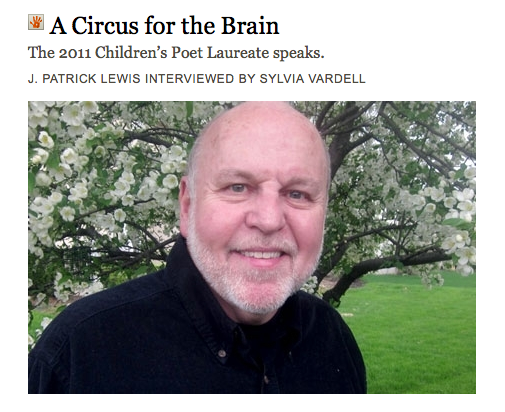
As J. Patrick Lewis moves forward as the new Children's Poet Laureate, I wanted to share two new sources of info about him and his work. The Poetry Foundation (sponsors of the CPL) features a new interview I did with him entitled, "A Circus for the Brain; The 2011 Children’s Poet Laureate Speaks." It's available on their web site here.


Plus, they have a regular podcast feature hosted by Curtis Fox called "Poetry Off the Shelf." He and I spoke about Pat, his work, and the CPL in "The New Johnny Appleseed of Children’s Poetry" which is recorded and available here.


Enjoy!


Image credit: Poetry Foundation

Posting by Sylvia M. Vardell c 2011. All rights reserved.

Thursday, February 25, 2010

Poetry Podcasts and Poem Audiofiles

I’m tickled to share news of a new venture in poetry promotion: I’ve created my first podcast! I’ve been wanting to try that for awhile and finally gave it a shot. Thanks to Terry Borzumato-Greenberg at Holiday House who invited me to create something for their Web site and jump-started my learning process. You’ll find two free downloadable audiofiles at the Holiday House web site. I share ideas about how to use two of their books with kids, read excerpts aloud, as well as provide tips on using poetry with kids, in general.

My
Poetry Podcasts
*Alice Low's The Fastest Game on Two Feet and Other Poems About How Sports Began (Holiday House, 2009) Podcast here


*Dian Curtis Regan’s poetry-focused picture book Barnyard Slam (Holiday House, 2009) Podcast here


I’m a big fan of introducing kids to the audio qualities of poetry and have written about that before—particularly about seeking out audiobook versions of poetry like the amazing Jazz by Walter Dean Myers (our first Odyssey audiobook award winner). But there are also free audiofiles of poetry available on the web—more and more as time goes on. Here are some of the major sites:

The Academy of American Poets
Audio archives alongside extensive biographical information and selected poetry

The Poetry Magazine
Audio recordings of many major poets reading their works, as well as interviews with and speeches

Poets and Writers
Offers multimedia slideshows, videos, and podcasts of all kinds of poetry-related material

The Library of Congress Poetry and Literature Center
An archive of recordings of over 2000 adult poets reading their own work

Just One More Book
Clever coffee shop podcast recordings of hundreds of booktalks and interviews

LibriVox
Amateur recordings of books in the public domain including some poetry

Favorite Poem Project
Poet Laureate Robert Pinsky’s project to have average citizens audiotape their favorite poems

Poetry Speaks
I’ve been meaning to post about the Poetry Speaks web site since I learned about it late last year—still being beta-tested. The Sourcebooks people who brought us Poetry Speaks, Hip Hop Speaks to Children, My Hippo has the Hiccups, The Tree that Time Built, and the upcoming Poetry Speaks; Who I Am (for middle school) are making audiofiles of poetry readings available (like the CDs that accompany each of their books), as well as the opportunity to download our own poem readings. Cool!

Poets whose Web sites feature audio recordings of their poetry:
Kristine O’Connell George
Janet S. Wong
Nikki Grimes
Joyce Sidman
Jack Prelutsky
Shel Silverstein

ACTIVITY: If audio announcements are made at your school or library, include the oral reading of a poem by the poet (downloaded) or by a child or adult volunteer on a daily or weekly basis. And of course with the simplest equipment you can encourage kids to record themselves reading their own poetry (or favorite poems) to share with friends and family.

Just for fun, here's a glimpse from Alice Low's clever and informative collection of sports-themed poems, The Fastest Game on Two Feet, featured in my podcast. It's an excerpt from the poem "Sonja Henie, Girl in White" about the Norwegian figure skater who revolutionized the sport in the 1920's-- in honor of last night's beautiful performances by Olympic figure skaters from Korea, Japan, Canada-- and the U.S.

Sonja Henie, Girl in White (p. 20)

by Alice Low


She started winning championships

When she was only eight.

When she was ten she won again.

Oh, how that girl could skate!


She practiced seven hours a day

And studied ballet, too,

And fused ballet with skating

In a style that was new.


There isn't room to list

The countless titles that she won.

The Worlds, ten times, Olympics, three.
And still she wasn't done.


For more Poetry Friday fun go to Check it Out today.

Posting (not poem) by Sylvia M. Vardell © 2010. All rights reserved.
Image credit: amazon; holiday house;skating.wikia.com;timesleader.com

Saturday, April 11, 2009

Another Hughes gem

It was amazing to me to learn that Langston Hughes was 18 when he composed the poem, “The Negro Speaks of Rivers,” the text for this new poem picture book illustrated by E. B. Lewis.

18!

Here is another classic Langston Hughes poem adapted into picture book form, this time with luscious watercolor illustrations by E. B. Lewis. Gorgeous landscape and portrait paintings appear in 13 double-page spreads, with one line (or half line) of the poem accompanying each of these panel illustrations. Each scene is its own strong mini-poster—classically beautiful and full of light.

The art has a very contemporary feel, except for the image of Lincoln and the final page suggesting a Black spirit ancestor. In the “Illustrator’s Note,” Lewis writes that as he worked on this book, “Hughes’s work became as personal as a prayer.”

He goes on to say, “Water has played a powerful role in the lives of black people…. In many ways, my life is like this poem: water almost ended my life; but now, through my watercolors, it has cultivated the spring of it.” He even places an image of himself praying, with the river embracing him, accompanied by the words, “My soul has grown deep like the rivers.” This image is repeated on the back of the dust jacket. Many people much smarter than I am have written about the possible meanings and interpretations of Hughes’s words, and Lewis offers a visual story that is full of emotion and heart.

The full text of the poem also appears on a single page at the end of the book. As an added bonus, look for the audio recording of Hughes himself reading this poem available online here. He even speaks briefly about the backstory behind the writing of this poem.

Sharing this wonderful work with kids will lead to many discussions—about the poem’s meaning, the symbolism of the river, the many places cited, the history of African and African American peoples, and even the use of the word, “Negro.” Teen readers may be inspired to write (or paint) their own poetic visions-- just like Hughes did when he was a teenager (and beyond)!

Hughes, Langston. 2009. The Negro Speaks of Rivers. Ill. by E. B. Lewis. New York: Disney-Hyperion.

Image credit: search.barnesandnoble.com

Friday, March 20, 2009

World Poetry Day + A/V Poetry

One of my students stumbled upon a mention of World Poetry Day that was new info to me. Apparently, it’s that time again: March 21. According to the ReadWriteThink curriculum Web site, “Believed to have its origin in the 1930s, World Poetry Day is now celebrated in hundreds of countries around the world. This day provides a perfect opportunity to examine poets and their craft in the classroom. In 1999, UNESCO (the United Nations Educational, Scientific, and Cultural Organization) also designated March 21 as World Poetry Day."

I’m heading off to Bologna, Italy today for my very first trip to the world famous Bologna Children’s Book Fair. I’ll be attending in my role as the new (co) editor of Bookbird, the journal on international children’s literature, and I’m hoping to learn, learn, learn. I also hope to find some wonderful, new international poetry for young people. Wouldn’t that be fun?

In the mean time, I’d also like to share an excerpt from my March Book Links “Everyday Poetry” column focused on multi-media options for poetry. If you’re looking for fresh ways to approach poetry with young people, you might consider multi-media methods for experiencing the visual and aural qualities of poetry. Using popular Internet sites, CDs, and a variety of software, you can lead kids in exploring the imagery, emotion, and language of poetry in ways that are creative, playful and multi-sensory.

VIDEO-- Look to the Internet for many examples of poetry in various visual formats. On Teacher Tube.com, you can find school-friendly video vignettes of young people reading poetry aloud, including their own original poetry, as well as teachers presenting a variety of poetry lessons…. Nearly everyone enjoys searching You Tube.com for fun, but it can also be a great site for poetry resources. One new trend is the video book talk or book trailer. Some are created by the poet, some by the publisher, and some by fans—a project possibility for kids, teachers, and librarians.

AUDIO--
There are several places to find audio adaptations of poetry for young people. Many are available as CDs accompanying print books…. Many poetry-related web sites include audiofiles among their links, such as The Academy of American Poets, Poetry Magazine.com, Poets and Writers, Inc., LibriVox.org for amateur recordings of books in the public domain, and the Favorite Poem Project …. More and more children’s poets are making audio recordings of themselves reading their own poetry available on their personal web sites…. As children experiment with technological tools of all kinds, they can be very savvy about finding creative ways to express themselves through poetry.

For examples of many of these sites and sources, check out the rest of the column. And once again, we have a lovely poem to accompany the column—a spring gem by Bobbi Katz. It’s beautifully formatted on the Book Links page for educator use.

Onion Snow
by Bobbi Katz


I wake to heavy quiet this April morning:
a special weighted sound.

Outside my window snowflakes fall

softly, softly feathering the ground-
softly, softly bearding the daffodils.

Grandma always called it onion snow.

Arriving when wild onions have started to grow,

those foolish fat flakes don't seem to know

they are too late for winter
and misfits in spring.

"Come listen to that onion snow!"

she would have said.
"Have you ever heard
such a silence??”


Copyright c 2008 by Bobbi Katz; used with permission.

Linda, a blogging colleague is also sharing her thoughts about this Book Links column at Write Time. Check it out.

Join this week's Poetry Friday crew at Wild Rose Reader. Thanks for hosting, Elaine!

Image credit: http://www.bookfair.bolognafiere.it/bcbf09_index.asp?m=107&l=1&ma=356;ala.org

Friday, February 20, 2009

Happy birthday, Kenn (My Hippo Has the Hiccups) Nesbitt

Poet Kenn Nesbitt is celebrating his birthday today, as well as the imminent release of what is sure to be a hit, My Hippo Has the Hiccups, a new poetry book-plus-audio-CD produced by Sourcebooks. This Silverstein-Prelutsky-influenced collection of 120 poems caters to kids’ voracious appetites for humorous story poems, with plenty of silly pet poems, fairy tale parodies (another Cinderella poem for my collection!), and funny school poems, many topics with strong kid appeal. Nesbitt relies heavily on formulaic rhyming quatrains that kids will quickly chime in on—especially after listening to the CD performed by Nesbitt himself.

Once again, the audio is one of my favorite components and I’m so glad to see Sourcebooks continue to offer poetry for kids in audio form. Nesbitt is a strong performer of his own works, with a strong, clear delivery and pacing that is just right for the poem and the audience. The pause between tracks is also helpful for listeners and Nesbitt manages to make each track distinctive, using a variety of voicing and sound effects. Even without the text in front of her/him, the young reader can easily follow the poem—and that’s not as easy as it sounds.

There are 39 (out of the 120) poems available on the CD including most of the best of the collection, IMO, like “I Played a Game” which begs for kid pantomime or movement to accompany the audio, “(I’m Always in Parentheses)” which actually gives voice to the ignoble parentheses, and “Pet Shopping” with a lively backdrop of animal noises, to name a few. Kids will surely want to plug the CD in the car and join in—and I think the CD will hold up to repeated listening.

My favorite poems are probably those that diverge from the ever-present rhyming pattern (like the list format of “The Contents of My Desk” below) or incorporate clever wordplay (like “Anna Graham” = anagram) or punctuation-play (like “Hap-the-Happy-Hyphenator”). I hope Nesbitt will venture further into this inventive territory in the future.

The Contents of My Desk
by Kenn Nesbitt

A nail.

A nickel.

A snail.

A pickle.

A twisted-up slinky.

A ring for my pinky.

A blackened banana.

A love note from Hannah.

My doodles of rockets.

The lint from my pockets.

A fork-like utensil.

But sorry…

no pencil.


p. 22


[Wouldn’t it be fun to gather a few of these objects mentioned in the poem and put them in a box, set the box on a table in front of the kids, and then take each object out as you refer to it in reading the poem aloud? Poem props! Or challenge kids to create a comic strip or storyboard, with a drawing for each line of the poem, using each line as a caption or speech bubble.]

My Hippo Has the Hiccups is illustrated with black and white cartoon sketches by artist and animator Ethan Long. They have just the right touch of zany looseness to suit the poems and engage kid readers—and aspiring cartoonists.

Kenn Nesbitt’s web site, Poetry4Kids is one of the most popular and visited sites for kids on poetry, offering a multitude of resources and opportunities for kids to interact. He clearly has a heart for kids and their funny bones. He writes, “I know it always makes me feel good when I read a funny poem or hear a funny song. So, in my own small way, I'm trying to do my part to help people laugh, and just maybe make the world a happier place.” Happy birthday to YOU, Kenn. Thanks for hiccupping hippos!

P.S. Congratulations, Sourcebooks: The 40th NAACP Image Awards were given out last week and Hip Hop Speaks to Children, edited by Nikki Giovanni (Sourcebooks/Jabberwocky) won for Outstanding Literary Work—Poetry, the first time that a book for CHILDREN has won in this category. Congrats, Nikki and Sourcebooks! (I blogged about this anthology last Nov. 4. Love that audio, too!)

Join the Poetry Friday crew at the holly and the ivy.

Image credit: Sourebooks

Monday, November 03, 2008

Hip Hop Today

I recently read on Publisher’s Weekly Children’s Bookshelf that the poetry collection, Hip Hop Speaks to Children (Sourcebooks/Jabberwocky), a collection of 51 songs and poems edited by Nikki Giovanni, is a huge hit. It’s #9 on the New York Times children’s picture book bestseller list with 30,000 copies already in print. And compiler Nikki Giovanni appeared on NPR’s “All Things Considered” last month to talk about it.

It’s been reviewed by many others already, with excellent commentary on the variety of poems, poets, illustrators, and voices represented. So… I’d like to focus on my favorite element: the AUDIO component-- the CD that accompanies the book. As a previous member of the Odyssey Award for Outstanding Audiobooks committee, I’m always seeking out quality audiobooks for young people, particularly poetry on audio. And here is a gem!

There are 36 (!) tracks, and each track is a stand-alone treat, moving from spoken word to music and lyrics back and forth in a varied and pleasing way. I would almost argue that one should begin with the audio alone first. There is nothing quite like hearing a poem read by the poet himself or herself. It etches itself into one's aural memory. Hearing the voice of Langston Hughes in an old recording of his own reading of his poetry is a window into time. Martin Luther King, Jr.’s “I Have a Dream” speech is here, alongside a modern re-interpretation of it. A few tracks provide Nikki Giovanni's commentary on the history or context for a particular poem or song-- I almost wished for more of that. What an amazing archive of music and poetry history this is for this and future generations.

My only complaint is that the volume varies a bit, but that's partly due to the inclusion of aging clips from more technologically simple days (a Langston Hughes recording from the 40's, I think) and partly due to a variety of readers (some close to the mic and others farther), but only the purist would quibble.

The range of selections is tremendous and provides a window into African American poem history, the blurring of music and poetry, and the voices of color that have contributed to poetry for young people for over half a century. As we consider the potentiality of an African American President for our country, this collection could not come at a better time. It's a celebration of sound and song in poetry for young people of all ages, colors, and political parties. It holds up for listening to over and over again, an excellent sign for any work!

My favorite nugget is Oscar Brown, Jr.’s “Dat Dere” (Track 18, with a short intro by Giovanni on Track 17; pages 26-27). I wish I could import the audio track, but I'm stumped. But here is the NPR podcast interview with Giovanni. I wish all the poems in the book were available on the CD; I wish there were more poetry books for children on audio; I wish we had more audio recordings of more poets writing for young people. Audio + poetry = unforgettable! Thanks, Sourcebooks. Keep it up!


[The publisher, Sourcebooks, has plans for more anthologies for kids next fall; another Poetry Speaks to Children anthology, edited by Elise Paschen, for middle-school readers, and The Tree That Time Built, edited by Mary Ann Hoberman and Linda Winston, an anthology of poems celebrating science, nature and the environment, also for middle-school readers. Sounds wonderful! I hope there is a CD with each of these books, too.]

Picture credit: booksofsoul.com
Saturday, April 05, 2008

Come to our Odyssey party!

If you’re planning to attend the ALA (American Library Association) conference in Anaheim in June, I’d like to make the following plug for your consideration. As a member of the very first Odyssey committee, I’m especially excited to see this inaugural event. Hope you’ll join us!

This year’s Booklist Books for Youth program in Anaheim will be devoted to the new Odyssey Award, given for excellence in audiobook production. The award will be presented to Arnie Cardillo of Live Oak Media, for his production of Walter Dean Myers’ Jazz, and five honor productions will be recognized. Speakers include Arnie Cardillo, author-audiobook producer Bruce Coville, and celebrated audiobook reader Simon Vance. There will also be plenty of entertaining clips from the winners. The award, selected and administered by a joint committee representing ALSC and YALSA, is sponsored by Booklist. Join the celebration on Friday, June 26, 8-10 p.m.

What’s the poetry connection? You may recall that the winner is JAZZ, a book of poetry! I’ve blogged about Jazz before because I just love that book. You may remember that I wrote about this book previously when it received a Coretta Scott King Illustrator honor citation, was selected as one of the five poetry books nominated for the Cybils Award, and appeared on my very own list of the “Best Poetry for Children in 2006.” Now, the audio adaptation has won the very first Odyssey Award. Clearly, it is a terrific book! As I noted previously, it’s a vibrant picture book poetry collection that is a celebration of jazz music and history and a tribute to New Orleans. The language is vivid and participatory and the art is obviously prize winning—sprawling and expressive. It also includes a helpful “Introduction,” “Glossary of Jazz Terms,” and a “Jazz Time Line.” And the illustrations in Mardi Gras colors of green, golds, and purples just leap off the page, the perfect accompaniment to the lively language.

The audio production is an amazing creation that takes the book even further. It is beautifully narrated by two performers, by James "D-Train" Williams and Vaneese Thomas with the perfect juxtaposition of male and female voices. Their delivery alone is milk and honey, but Live Oak Media commissioned original jazz music as a backdrop for the poetry, too. Incredible! The music takes this lyrical and rousing poetry to a new level. As we wrote in the press release for the announcement, “Original music accompanies each poem's performance, resulting in a rhythmic representation of mood and tone. Separate tracks for the selections and lively inclusion of a glossary and timeline create a dynamic audiobook; part poetry, part nonfiction, and wholly authentic.”

Picture credit: http://www.ala.org/ala/alsc/awardsscholarships/literaryawds/odysseyaward/odysseyawardcurrentwinner/odysseycurrentwinner.cfm