Showing posts with label international. Show all posts

Friday, June 08, 2012

White Ravens poetry 2012

Each year the language specialists (Lektoren) at the International Youth Library (IYL), in Munich, Germany, select newly published books from around the world that they consider to be especially noteworthy. This list of books is compiled into the annual White Ravens list, which is introduced each year at the Bologna (Italy) Children's Book Fair.

The White Raven label is given to books that deserve worldwide attention because of their universal themes and/or their exceptional and often innovative artistic and literary style and design. The titles are drawn from the books that the IYL receives as review or donation copies from publishers and organizations around the world.

When I was attending the Bologna Book Fair (as part of my Bookbird editor duties), I had the opportunity to examine all the White Ravens books as the list was announced-- what a treat! I was able to study the poetry selections, in particular, and even photograph the books and last year had volunteers read poems from some of the poetry books in the different languages-- and I posted those mini clips. Such fun! I wasn't in Bologna this spring, but fortunately the White Ravens list is searchable online. So, I've done the homework and have pulled all the poetry selections here for you below-- there's such a range in tone, style, and content. (Annotations from the IYL.) In the 2012 list, you'll find 18 books of poetry for children from Australia, Austria, Belgium (including a CD), Canada, and Haiti-via-Canada, Chile, Cyprus, Germany, Hungary, Italy, the Netherlands, Norway, Russia, Slovenia, and the USA. Enjoy!

Here's the link to the complete current White Ravens catalog (2012).

You'll also find more info at the International Children's Digital Library, a searchable database of thousands of international books for young people, including the White Ravens catalog.

AUSTRALIA
Blabey, Aaron (text/illus.) 

The ghost of Miss Annabel Spoon 

Melbourne [et al.]: Penguin / Viking, 2011. – [32] p. 

ISBN 978-0-670-07474-7 

Ghost – Fear – Loneliness – Friendship 

The poor people of Twee, »seven miles from the sea«, are in uproar. A frightful ghost is haunting the village. Be it morning, midday, or the middle of the night, whenever the spooky spectre of Miss Annabel Spoon appears, she creates havoc among the population. How can they get rid of her? Young Herbert Kettle, elegantly clad in grey jacket and top hat, bravely sets out to save his neighbours and finds an unusual solution. Aaron Blabey’s exquisite picture book is told in six-line tail-rhymed stanzas and in gothic illustrations rendered in acrylics, pencil, and pen in shades of grey, brown, and olive. Both the catchy text and the dark pictures (in particular the pale ghost-lady with her dark-rimmed eyes and rigid posture) will remind readers of the classic nonsense poetry of Edward Lear and Edward Gorey. (Age: 4+)

AUSTRIA
Schawerda, Elisabeth (text) 

Bansch, Helga (illus.) 

Das Geheimnis ist blau 
(The secret is blue)

Wien: Wiener Dom-Verl., 2011. – [26] p. 

ISBN 978-3-85351-228-9

Colour – Association – Poetry

The fat toad on the cover notwithstanding, this book is not about amphibians. It is filled with poems about colour. The first, »Colour play«, reveals a spectrum subsequently differentiated. It describes turquoise water, yellow lemons, and a green garden: »Lift your head up, / under linden, beech and pine, / you can see, touch, smell, hear / all that which is green and fine«. Synaesthesia and personification occur frequently in the texts, while verse and rhyme forms vary. The illustrations are collages made from maps and newspaper clippings, and often also water-coloured pencil drawings. While the poems are about vibrant colours, the pictures themselves are slightly muted by the greyish undertone typical of Helga Bansch’s style. This lends them a delicate patina. (Age: 5+)

BELGIUM
Dewitte, Jan (text)

Vlerick, Freya (illus.)

Rare snuiters. Een prentenen gedichtenboek
(Odd animals. A picture- and poetry book)

Gent : Poëziecentrum, 2011. – [36] p. + CD

ISBN 978-90-5655-104-9

Animals – Poetry

»Rare snuiters« is an extraordinary picture and verse book that is explicitly aimed at people with a visual handicap and children with dyslexia. The short, humorous poems are about animals, one for each letter of the alphabet, ranging from ‘Aap’ (monkey) to ‘Zwaan’ (swan). The top of each page contains a silhouette of the animal, set out in relief, and features the name of the animal in Braille. The poet even found a solution for tough letters (like X and Y), although this required some creativity; an example is the X-osaurgoat that lived long ago. The illustrations are large-planed and have an atmospheric, yet high-contrast colour scheme. This ensures that visually impaired people can view them as well. Moreover, all the images can be felt because set in relief. The photos of human eyes that have been incorporated into every image literally add a special touch. The poems themselves are not offered in Braille, but can be listened to via the included CD. (Age: 8+) H Special Mention

CANADA
Phillips, Wendy 

Fishtailing 

Regina, Sask.: Coteau Books for Teens, 2010. – 196 p. 

ISBN 978-1-55050-411-8 

Teenage angst – Coming of age – Bullying – Abuse – Poetry

This award-winning free verse novel demonstrates the power of poetry both in its form and content. Thanks to poetry assignments from English class, four Vancouver high school students give voice to their conflicted inner lives: to their dreams and nightmares, their hopes and disappointments. These short, intense poems address issues of abuse, bullying, racism, violence, fitting in, love, and following your dreams. Far from presenting abstract musings, they use tangible imagery to develop the cruel plot, which seems to unfold from the characters’ inner turmoil. The interspersed e-mails between a concerned guidance counselor and the old-school English teacher as well as comments the teacher makes on her students’ assignments show adults largely out of touch with the tough teenage world. (Age: 14+) 
(2010 Governor General’s Award for Children’s Literature)

CANADA
Various authors (text)

Rogé (illus.)

Haïti, mon pays. Poèmes d’écoliers haïtiens (Haiti, my country. Poems by Haitian students)

Montréal (Québec): Éd. de la Bagnole, 2010. – [42] p. 

ISBN 978-2-923342-50-4.

Haiti – Poetry

These powerful, evocative poems about Haiti, written by young people from the Southwest of that country, were written in 2008/2009 – before the severe earthquake of January 2010. They celebrate the beauty of the country, its (immaterial) riches and magic, yet also deal with poverty and the uprooted population. The striking large-format portraits of Haitian children and adolescents by Franco-Canadian illustrator Rogé accompany these hopeful texts. Dany Laferrière, the well-known Haitian author, justly writes in his introduction that »in Haiti, poets grow faster than trees from the earth«, and it is this youth that embodies the future of the sorely stricken country. (Age: 8+)

CHILE

Beuchat, Cecilia (ed./text)

Hojas, Isabel (illus.)

Palabras, regalo palabras (Words, I give away words)

Santiago, Chile: Liberalia Ed., 2011. – 141 p.

ISBN 978-956-8484-12-5

Poetry – Language

Compiled by Chilean children’s book author and expert Cecilia Beuchat, this volume contains a marvellous selection of Spanish-language poems wonderfully well suited to reading aloud or to oneself. Beside examples of well-known poets such as Rafael Alberti, Pablo Neruda and Gabriela Mistral, one predominantly finds contemporary poems, which document the diversity and richness of the genre that plays such a crucial role in Latin American children’s literature. The editor is especially concerned to sensitise readers to the beauty and playful character of language. She has organised the poems into chapters and prefaces each chapter with an everyday word or a less usual, special one. Building on these, she binds images, feelings, and memories together, which she shares with readers in a short personal introductory text. Isabel Hojas illustrates the book in a wide range of manners. Her pictures, rich in form and colour, reveal very well the mood of each text. (Age: 8+)

CYPRUS (Greek) (Romanisation according to RAK-WB [German cataloguing rules])

Eleutheriadu, Nasia (= Eleftheriadou, Nasia ) (text)

Papatsaruchas, Basilēs (= Papatsarouchas, Vasilis) (illus.)

Stu synnephu tēn ankalē me chara kanē petali (Up in the clouds I pedal happily)

Strobolos: Parga, 2011. – [40] p. 

ISBN 978-9963-679-86-7

Experience of nature – Perception – Poetry

This refreshing collection of poetry can get children excited about the little joys of everyday life and experiences with nature, which are for them so important and wondrous. It will encourage them to approach nature with curiosity, playfulness, and amazement and to perceive it with all the senses. Silver moonbeams trace paths into dreaming, cool water melons invite diving into, and there is sailing on the wide sea. Sunrays inhibit sleeping too long, and going to the candy cane playground is the most fun. The expressive illustrations are in dialogue with the verses, interpreting them and allowing for multiple meanings. Anyone reading, listening, and looking can thus access the poems in a way that is entirely their own. (Age: 4+)

GERMANY
Schmitz-Kuhl, Martin (text) 

Kuhl, Anke (illus.)

Alle Kinder. Ein ABC der Schadenfreude (For all children. An ABC of schadenfreude)

Leipzig: Klett Kinderbuch, 2011 – [56] p. 

ISBN 978-3-941411-42-5

Schadenfreude – Poetry

They aren’t the cream of the crop morally speaking, and they aren’t quite above board pedagogically speaking – but that’s exactly why these twenty-six malicious little stories, compiled in picture book form by Martin Schmitz-Kuhl and Anke Kuhl, are so much fun. A small taste?: »All the kids jump through the hoop / except Pat – he is too fat.« The short couplet with internal rhyme is not a new verse form, but with the help of their children, the Kuhl couple has conjured up fresh and surprising sayings. Anke Kuhl, who was awarded the Deutscher Jugendliteraturpreis (German Children’s Literature Award) in 2011 for her book »Alles Familie!« (Everyone is family), translates their mischievousness into image-form. Big and little alike will laugh aloud and want to think up their own mean little stories, because ultimately he who laughs last still laughs best. (Age: 5+)

GERMANY
Schneider, Antonie (text)

Pin, Isabel (illus.)

Kartoffeln in Pantoffeln (Potatoes in slippers) 

Berlin: Aufbau, 2011. – [32] p.

ISBN 978-3-351-04134-2

Vegetables – Word play – Poetry

In »Kartoffeln in Pantoffeln«, the protagonists are asparagus, artichokes, and – oh crumbs – spinach. True, greens may not be the favourite food of little chip lovers; yet Antonie Schneider and Isabel Pin serve their miniature vegetables so lovingly and passionately that even fervent advocates of junk food cannot but devour them. The anthropomorphic vegetables often find themselves in unexpected situations. Thanks to a sophisticated dramatic arc, the texts oscillate between tragedy and partly absurd comedy. The same is true for Isabel Pin’s carefully composed illustrations. Carrot- and broccoli-adventures tempt readers to gaze at the pictures, create their own poems, and maybe even re-enact the tales; and the prospective protagonists can simply be cast on the readers’ plates at lunchtime. (Age: 4+)

HUNGARY
Rigó, Béla (text)

Perger, Zsófia (illus.)

Nálatok laknak-e állatok? (Do animals live with you?)

Budapest: Ulpius-ház K., 2011. – 73 p.

ISBN 978-963-254-509-7
Family – Child – Animals – Poetry

This book contains playful, imaginative children’s poems from the pen of renowned Hungarian children’s book author Béla Rigó. The book’s title, which calls to mind an old poetry collection set to music, reveals that the anthology’s theme is transformation and metamorphosis. In the two central sections of the book – »Picture postcards for Grandma« and »Titi’s poem for Grandpa« – the author portrays two families using irony and a masterful use of language, focusing especially on the experiential world of the children. The most beautiful poems are devoted to the topics of birth and death. The granddaughter says to her grandmother: »I will become earth and you will become a flower«. The lively illustrations – colourful pencil drawings reminiscent of children’s drawings – lend much imagination to the text. (Age: 5+)

ITALY
Del Tufo, Chiara (ed.)

Vairo, Arianna (illus.)

Un paese bambino. Poesie per il 150° dell’Unità d’Italia (A fledgling country.
Poems for the 150th anniversary of Italy’s unification)

Bologna: Stoppani, 2011. – [48] p.

ISBN 978-88-86124-78-2

Italy/1861-2011 – Children’s rights – Poetry

Young illustrator Arianna Vairo’s original style sets the tone of this beautiful poetry anthology. Fifteen of Italy’s most important poets were invited to put dreams, freedom, war, rights, immigration, good etiquette and friendship to paper. With great care, they select special words: hushed words, words of recollection, of trains and of hopes, of expectations and movement – words lined up next to each other, dedicated to the children, their country and their future. Notable names in the table of contents include Roberto Piumini, Janna Carioli, Matteo Marchesini, Alessandro Riccioni, Giusi Quarenghi, Bruno Tognolini, Giovanna Zoboli and all others. (Age: 8+)

ITALY
Riccioni, Alessandro (text)

Baladan, Alicia (illus.)

Cielo bambino (Children’s sky)

Milano: Topipittori, 2011. – [28] p.

ISBN 978-888-92107-2-7

Poetry

Alessandro Riccioni is a masterful, sensitive and profound poet. His words skip lightly across the page. The emotion-laden pictures of Alicia Baladan at times are wonderfully child-like and at times full of allusion. For instance, they variously refer to the films of Georges Méliès, to the extraordinary journeys of Jules Verne, to the novel »Saturnin Farandoul« by Albert Robida and to a wonderful, fanciful amusement park. With a sophisticated simplicity, this poetry collection describes a sky rife with encounters, a magical sky that changes with the decades, a sky in which clouds and sheep chase each other, where space shuttles and moored balloons circulate, thousands of stars shine, and the sun and moon, light and darkness alternate. (Age: 5+)

NETHERLANDS
Lieshout, Ted van (text/illus.)

Driedelig paard. Blokgedichten, beeldsonnetten en tekeningen (Horse in three parts. Block poems, picture sonnets, and drawings)

Amsterdam: Leopold, 2011. – 87 p.

ISBN 978-90-258-5780-6

Poetry

This volume contains many different kinds of poetry, verbal poems, visual poems, and block poems, which combine both: the text block as visual poetic form and the verbal content. The combination of poetical forms and media provides for an exciting reading experience. In the first part, a boy writes a letter to his grandmother, and she writes back to him in the last part. In between, there are lots of other texts, ranging from complaint letters to newsletters to scribbles. Together they form a humorous panoply that tweaks reality and fiction. Different characters are writing each time, yet slowly it becomes clear that all of them are contributing to the story about the boy and his family. This book is exquisitely designed, featuring different fonts, colour illustrations of objects and page-filling photos of strictly structured tomatoes, spoons, and radishes, for example. (Age:12+)

NORWAY
Kaldestad, Per Olav / Bramnes, Hanne (ed.)

Various artists (illus.)

Sølvbåt og Stjernevind. Den nye barnediktboka (Silverboat and Starwind. A new children’s book of rhyme)

Bergen: Mangschou, 2011. – 183 p. 

ISBN 978-82-8238-020-1

Poetry

Small but mighty: in recent years Bergen publishing house Mangschou has distinguished itself through its ambitious projects. It is certainly an ambitious idea to produce a companion to the collection of verse »Den store dikt- og regleboka«, an old favourite in Norway. Well-known artists like Hilde Myklebust and Cathrine Grøndal, Øyvind Torseter and Inger Lise Belsvik were enlisted for »Sølvbåt og stjernevind«. The book thus makes possible a stroll through the landscape of current Norwegian authors and illustrators. First and foremost, though, this is an exceptional compendium of illustrated children’s verse, at once modern and timeless. Its scope reaches from two-line poems to ballads, from coloured pencil drawings to collage. Thanks to its diversity, it has what it takes to become a classic. (Age: 4+)

RUSSIA
Givargizov, Artur (text)

Jaskina, Natal’ja (illus.)

Kak-to ja letel s rjabiny (Somehow I tumbled down the rowan tree)

Moskva: Izd. dom Meščerjakova, 2011. – [61] p.

(Series: Stich i štrich)

ISBN 978-5-91045-310-8

Rogue – Trick – Poetry 

Typically Givargizov! Obstreperously, brashly, and meatily as usual, one of the most important Russian children’s book authors talks about children’s daily lives in anecdotic poems. Readers will laugh at little Sergej, who almost tumbled from a rowan tree and now greets passers-by while dangling upside-down from a branch with his shirt round his ears. Givargizov’s well-known humorous dialogues are also prevalent here, e.g. in the prank call from a pupil who overslept, to the school’s director. Young illustrator Natal’ja Jaskina (born 1985), who already illustrated some titles for the Russian-Austrian publishing house Meščerjakov, creates enchantingly lively settings for this poetry. The reduced palette of matt colours and the black outlines of pictorial elements are reminiscent of illustrations from the 1960s. (Age: 7+)

SLOVENIA
Pavček, Tone (text)

Bricelj, Suzi (illus.)

Po morju plava kit. Izmišljeno resnična pesnitev (A whale swims in the sea. An imagined true poem) 

Dob pri Domžalah: Miš, 2010. – [36] p.

ISBN 978-961-272-026-1

Whale – Faithfulness – Integrity – Self-esteem

The great Tone Pavcek died in 2011. For this verse narrative, in which he displays all his talent one last time, he has created wonderfully vibrant verses that effortlessly vary in tone from humorous to serious. The tale about a whale in the bay of Piran is told in an anecdotal style but, at the same time, it also issues a warning. The whale is loved and courted by the people – not least because they hope to increase tourism. When the initial euphoria turns into disinterest, the whale disappears into other seas. Wistful but also full of dignity, he returns one last time, then leaves forever. This parable-like story, accompanied by Suzi Bricelj’s tender pictures, was nominated as picture book of the year 2011 – and rightly so. (Age: 5+)

USA
Gerstein, Mordicai (text/illus.) 

Dear hot dog. Poems about everyday stuff 

New York, NY: Abrams Books for Young Readers, 
2011. – [32] p.

ISBN 978-0-8109-9732-5 

Anthropomorphism – Everyday object – Poetry

Bear and books, cup and crayons, socks and scissors have one thing in common: They are all inanimate everyday objects. Not so in this colourful collection of poetic poems! The quiet, pondering texts written from the viewpoints of two boys and a girl directly address the objects as if they were people or animals; e.g. a toothbrush turns into a close friend: »All night / dozing in your holder / you wait for me. / I give you toothpaste / for breakfast/ mint / your favourite...« Clearly enjoying their daily routines and small adventures, the three young protagonists in award-winning author and illustrator Mordicai Gerstein’s book breathe new life into familiar things. The bright acrylic illustrations with thin wriggly outlines add an atmosphere of exuberance and joy to the calm poems. (Age: 4+)

USA
Salas, Laura Purdie (text) 

Bisaillon, Josée (illus.) 

BookSpeak! Poems about books 

Boston [et al.]: Clarion Books / Houghton Mifflin 
Harcourt, 2011. – [30] p.

ISBN 978-0-547-22300-1 

Book – Poetry 

Books are usually there to be read. They affect their 
readers through their stories – but never speak out loud. In this colourful collection of poems, however, books and everything book-related finally get their say: The Index stresses its singular importance; the Book Plate poses a kind of riddle; the Cliffhanger demands »… Please, author, write / a sequel fast!«; and the book’s Middle complains about its current state trying to persuade either The Beginning or The End to trade places with it just this once – all in vain. Accompanied by Québécoise illustrator Josée Bisaillon’s versatile mixed-media illustrations created from collages, drawings, and digital montage, the quirky poems will fascinate and amuse young book aficionados and inspire them to compose their own bibliophile odes and ballads. (Age: 6+)

Join the rest of the Poetry Friday fun at Jama's Alphabet Soup. See you there!

Monday, April 30, 2012

New world poetry for Día 2012

In honor of El día de los niños/El día de los libros/ Children's day/Book Day today, I'd like to highlight three books from outside the U.S.

Argueta, Jorge. 2012. Guacamole; Un poema para cocinar/ A Cooking Poem. Ill. by Margarita Sada. Toronto: Groundwood.

From the publisher, Groundwood Books: "Jorge Argueta’s third book in our bilingual cooking poem series is — Guacamole — with very cute, imaginative illustrations by Margarita Sada.

Guacamole originated in Mexico with the Aztecs and has long been popular in North America, especially in recent years due to the many health benefits of avocados. This version of the recipe is easy to make, calling for just avocados, limes, cilantro and salt. A little girl dons her apron, singing and dancing around the kitchen as she shows us what to do. Poet Jorge Argueta sees beauty, magic and fun in everything around him — avocados are like green precious stones, salt falls like rain, cilantro looks like a little tree and the spoon that scoops the avocado from its skin is like a tractor.

As in the previous cooking poems, Guacamole conveys the pleasure of making something delicious and healthy to eat for people you really love. A great book for families to enjoy together."

Here is the cutest book trailer for Guacamole complete with a foot-tapping song to enjoy!


Be sure to check out his other bilingual "food" poetry collections:
Argueta, Jorge. 2009. Sopa de frijoles/ Bean Soup. Ill. by Rafael Yockteng. Toronto, ON: Groundwood.
Argueta, Jorge. 2010. Arroz con leche; Rice Pudding. Ill. by Fernando Vilela. Toronto, ON: Groundwood.


Luján, Jorge. 2012. Con el sol en los ojos/ With the Sun in My Eyes. Ill. by Morteza Zahedi. Toronto: Groundwood.

From Groundwood: "In this book of short poems in Spanish and English, a young boy and girl describe their world and their day-to-day experiences -- the boy's street is like the trunk of an almond tree and the newborn chicks are like tiny walking suns. The girl loves her dog Oliver, the wind hitting her in the face and laughter "that explodes for no reason." But the children also ponder mysteries, such as the loud silence the boy hears inside himself when he goes for a walk alone and the vast beauty of the sky, with its clouds and constellations.

Once again Jorge Luján brings young readers a lyrical and joyful collection of poems. Morteza Zahedi's powerful illustrations in densely saturated colors perfectly complement the poems' subtle explorations."


I Saw a Peacock with a Fiery Tail. Ill. by Ramsingh Urveti. 2012. London: Tara Books.

From Tara Books: "A well-known folk poem from 17th century England, 'I Saw a Peacock with a Fiery Tail' is a form of trick verse. The poem at first seems nonsensical, but given a break in the middle of each line begins to make perfect sense.

In this pioneering visual exploration of I Saw a Peacock, Gond tribal artist Ramsingh Urveti and book designer Jonathan Yamakami use art and design in the service of language. Working together, revealing and concealing, they brilliantly mirror the shifting ways in which poetry creates meaning."

This book is truly exquisite in art, design, and construction-- but it's also elegant and simple and kid-friendly. The lines of the poem curl this way and that through multiple pages across the blue-black-white palette of the die cut pages.

It begins:

I saw a peacock with a fiery tail
I saw a blazing comet drop down hail
I saw a cloud with ivy circled around
I saw a sturdy oak creep on the ground

Get it? The playful nature of the lines and how they are tucked into the art beg for repeated examination. The thick pages cut with holes and curves and stars offers a tactile experience that takes the simple poem to another level. It's hard to describe adequately, so I urge you to get your own copy, share it with a 10 year old you love, and see what happens. It's the best paper "app" you'll find this year-- read it multiple times, backwards and forwards, talking about the lines, the art, the pages, and making up your own imitation poems!


Happy El día de los niños/El día de los libros/ Children's day/Book Day one and all!


P.S.
And I've already highlighted the following collection in the 5Q interview series-- it also includes a global selection of poets:

Hoyte, Carol-Ann and Roemer, Heidi Bee. Eds. 2012. And the Crowd Goes Wild!: A Global Gathering of Sports Poems. Ill. by Kevin Sylvester. Neche, ND: Friesens Press.


Image credit: 

Groundwood, Tara Books

Posting by Sylvia M. Vardell © 2012. All rights reserved.

Friday, November 04, 2011

London poetry conference

If you're going to be in London next weekend, there’s a fantastic poetry conference being held there organized by the IBBY UK and the NCRCL (National Centre for Research in Children’s Literature). If you go, please let us know all about it.


Here are the details gleaned from postings by Laura Atkins, Senior Lecturer at the NCRCL.

Date: Saturday, 12 November 2011
Location: University of Roehampton, London

Theme: “It Doesn’t Have to Rhyme: Children and Poetry”


The conference will explore aspects of poetry that impinge on young people, with a focus on the question “Why does poetry matter?” This begs the more fundamental question: What is poetry?” which they hope also to explore. Plenary speakers include Morag Styles, Michael Rosen, Jacqueline Wilson, Susan Bassnett and a panel of people involved with the publication and anthologizing of poetry.


Here is their Provisional Programme:


9.30 Registration and coffee, Terrace Room

10.00 Welcome (Pat Pinsent)

10:10 Morag Styles (Cambridge University)

11:00 Publishing panel: Janetta Otter Barry (Frances Lincoln), Gaby Morgan (Macmillan) and Fiona Waters (anthologist; Troubadour)

11:45 Comfort break (don't you love that label?!)

12:00 Michael Rosen

12:45 IBBY, NCRCL and 2012 World Congress news

1:00 Lunch, Montefiore Diner

2:00 Parallel workshops, see notices

3.15 Susan Bassnett (The Times Stephen Spender 2010 prizes judge).

3:45 Tea, Terrace Room

4:15 Jacqueline Wilson

5:00 Joelle Taylor (Poetry Society) Poetry Slam

5:30 Finish


Programme of Workshops

Workshop A

Sandra A. Agard. It Doesn’t Have to Rhyme.

David A. Whitley. Children’s Poetry: Loose Cannons and Loose Iambics.


Workshop B

Lucy Andrew. Riddles in the Dark: The Role of Poetry in Children’s Fantasy Novels from Alice to Harry Potter.

Rebecca R. Butler. Imaginative Opportunities in Two Verse Novels.


Workshop C

Kimberly Black. Social Protest in Urban Youth Spoken-Word Poetry.

Imogen Church. Authenticity of Voice in Poetry Written by Juvenile Offenders.


Workshop D

Julie Blake. Reclaiming the Oral Tradition: The Poetry Archive.

Mathew Carthew. Slam Dunk: Performance as a Way of Bringing Children’s Poetry to Life.


Workshop E

Fiona Collins and Alison Kelly. Poetry Journeys: From Child to Student Teacher.

Jenny Vernon. Ten Years of Children’s Poetry: The Southwark Poetry Anthologies.


Workshop F

Pat Ebhohimen. Is Poetry Written by Children really Poetry?

Robert Hull. Can a Love of Poetry be Taught?


Workshop G

Emily Roach. Dealing with Death: Tough Topics in Poetry for Children.

Siwan M. Rosser. Negotiating Borders: Poetry and the Language of Children.


Workshop H

Georgie Horrell. Caribbean Children’s Poetry in Multicultural Britain.

Aneesh Baria. Children and Cats in the Alley: T.S. Eliot’s Old Possum’s Book of Practical Cats and its French Translations.


Doesn't this look cool? I won’t be able to attend, so I contacted the conference organizers about whether proceedings of the conference would be published and I’m pleased to share that the answer is YES. There will be short abstracts if the conference in the Spring 2012 issue of IBBYLink. The journal goes out to all members of IBBY UK so if you are a member you will get that. The proceedings with the fuller papers will be published by Pied Piper Publishing in October 2012. So, I’ll watch for that and keep you posted!


Image credit: www.ncrcl.ac.uk


Posting by Sylvia M. Vardell © 2011. All rights reserved.

Friday, October 21, 2011

Poetry, peace and USBBY

This weekend I’m in Fresno, California attending the biennial IBBY regional conference with the theme, Peace the World Together Through Children’s Books. It’s sponsored by the US section of IBBY (the United States Board on Books for Young People), one of my favorite organizations since it’s devoted to international children’s literature. I’ve mentioned it many times, particularly since I love this conference and rarely miss it. In addition, I am winding up my 3 year term as co-editor of the IBBY journal of international children’s literature, Bookbird.

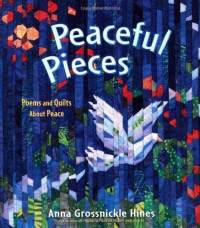
I will also be making a presentation on Saturday, “PEACE THROUGH POETRY FOR YOUNG PEOPLE” along with poet and artist Ann Grossnickle Hines, author of the recent poetry collection, Peaceful Pieces: Poems and Quilts About Peace. Our session will focus on how poetry, in particular, fosters the IBBY vision of working toward a more just and peaceful world by featuring:

• An introduction to and bibliography of poetry for young people from around the world, including print and online resources
• Poetry in bilingual editions (English and Spanish, Japanese, Irish, Slovakian, etc.)
• Poems and poets from around the world featured in Bookbird

Anna will talk about her new book which has already received starred reviews in Publisher’s Weekly and Booklist, Peaceful Poems, a collection of 28 short poems about peace, a broad concept interpreted in varied ways through poetry and quilt art. She notes, “All of us are together in one world, where everything we do, every action, every thought and every breath, creates the network in which we all live.”

It’s a beautiful book—in both the quilt art illustrations and the various manifestations of peace that the poems reflect. Here’s just one example:


Peace: A Recipe
By Anna Grossnickle Hines


Open minds—at least two.

Willing hearts—the same
.
Rinse well with compassion.

Stir in a fair amount of trust.

Season with forgiveness.

Simmer in a sauce o
f respect.
A dash of humor brightens the flavor.


Best served with hope.


And just in case you’re interested in the bibliography I’ll be sharing, here you go:

POETRY BOOKS FOR YOUNG PEOPLE ABOUT WAR AND PEACE, ETC.
Applegate, Katherine. 2008. Home of the Brave. New York: Square Fish.
Burg, Ann. 2009. All the Broken Pieces. NY: Scholastic.
Crist-Evans, Craig. 1999. Moon Over Tennessee: A Boy’s Civil War Journal. Boston: Houghton Mifflin.
Engle, Margarita. 2006. The Poet Slave of Cuba: A Biography of Juan Francisco Manzano. New York: Henry Holt and Co.
Engle, Margarita. 2008. The Surrender Tree; Poems of Cuba’s Struggle for Freedom. New York: Henry Holt.
Frost, Helen. 2009. Crossing Stones. New York: Farrar, Straus & Giroux.
Gordon, Ruth, comp. 1995. Pierced by a Ray of Sun: Poems about the Times We Feel Alone. New York: HarperCollins.
Greenfield, Eloise. 2006. When the Horses Ride by: Children in the Times of War. New York: Lee & Low Books.
Gunning, Monica. 2004. A Shelter In Our Car. San Francisco, CA: Children’s Book Press.
Heard, Georgia. 2002. This Place I Know: Poems of Comfort. Cambridge: Candlewick Press.
Hesse, Karen. 2003. Aleutian Sparrow. Simon & Schuster.
Hines, Anna Grossnickle. 2011. Peaceful Pieces: Poems and Quilts About Peace. New York: Greenwillow.
Holland, Trish and Christine Ford. 2006. The Soldiers’ Night Before Christmas. New York: Random House.
Hopkins, Lee Bennett. 2008. America at War. New York: McElderry.
Hopkins, Lee Bennett, comp. 1994. Hand in Hand: An American History through Poetry. New York: Simon & Schuster.
Hopkins, Lee Bennett, comp. 2002. Home to Me: Poems Across America. New York: Orchard Books.
Janeczko, Paul. 2011. Requiem; Poems of the Terezín Ghetto. Candlewick.
Johnston, Tony. 2008. Voice from Afar: Poems of Peace. New York: Holiday House.
Katz, Bobbi. 2000. We The People: Poems. New York: Greenwillow.
Lai, Thanhha. 2011. Inside Out and Back Again. HarperCollins.
Levy, Debbie. 2010. The Year of Goodbyes; A True Story of Friendship, Family and Farewells. New York: Hyperion.
Lewis, J. Patrick. 2005. Heroes and She-Roes: Poems of Amazing and Everyday Heroes. New York: Dial Books.
Lewis, J. Patrick. 2007. The Brothers’ War: Civil War Voices in Verse. Washington: National Geographic Children's Books.
LeZotte, Ann Clare. 2008. T4. Boston: Houghton Mifflin.
Longfellow, Henry Wadsworth. 2001. The Midnight Ride of Paul Revere. New York: Handprint Books.
Meltzer, Milton. 2003. Hour of Freedom: American History In Poetry. Honesdale, PA: Wordsong.
Nye, Naomi Shihab. 1998. The Space Between out Footsteps: Poems and Paintings from the Middle East. New York: Simon & Schuster.
Nye, Naomi Shihab, comp. 1999. What Have You Lost? New York: Greenwillow.
Rappaport, Doreen. 2008. Lady Liberty. Cambridge: Candlewick Press.
Robb, Laura, comp. 1997. Music and Drum: Voices Of War and Peace, Hope and Dreams. New York: Philomel Books.
Sidman, Joyce. 2007. This is Just to Say: Poems of Apology and Forgiveness. Ill. by Pamela Zagarenski. Boston: Houghton Mifflin.
Thomas, Shelley Moore. 1998. Somewhere Today: A Book of Peace. Morton Grove: Albert Whitman.
Vecchione, Patrice. 2007. Faith and Doubt; An Anthology of Poems. New York: Henry Holt.
Volavkova, Hana, ed. 1993. I Never Saw Another Butterfly: Children’s Drawings and Poems from Terezin Concentration Camp 1942-1944. New York: Schocken Books.
Walker, Alice. 2007. Why War is Never a Good Idea. New York: HarperCollins.
Yolen, Jane. 1996. Sacred Places. San Diego, CA: Harcourt Brace.

I'll also be sharing a bib of a sampling of wonderful international poetry for kids.

And my major points boil down to these three:
*poetry about peace can teach children about important concepts, events, experiences
*poetry from around the world can humanize other places that may be unfamiliar and provide a bridge of understanding
*poetry (period) encourages reflection, tolerance and peace (poets are lovers not fighters!)

Image credit: 

USBBY;AnnaGrossnickleHines; Greenwillow

Posting by Sylvia M. Vardell © 2011. All rights reserved.

Friday, October 14, 2011

What's new in novels in verse?

It’s been a boom year for publishing excellent novels in verse. I count nearly 20 of them, many of which I've written about earlier in the year. Here's my list (and please let me know if I've missed any in 2011):
  1. Chaltas, Thalia. 2011. Displacement. Viking.
  2. Engle, Margarita. 2011. Hurricane Dancers; The First Caribbean Pirate Shipwreck. Henry Holt.
  3. Frost, Helen. 2011. Hidden. Farrar, Straus & Giroux.
  4. Grimes, Nikki. 2011. Planet Middle School. Bloomsbury.
  5. Herrera, Juan Felipe. 2011. Skate Fate. HarperCollins.
  6. Hopkins, Ellen. 2011. Perfect. Margaret K. McElderry.
  7. Howe, James. 2011. Addie on the Inside. Atheneum.
  8. Janeczko, Paul B. 2011. Requiem; Poems of the Terezín Ghetto. Candlewick.
  9. Kehoe, Stasia Ward. 2011. Audition. Viking.
  10. Lai, Thanhha. 2011. Inside Out and Back Again. HarperCollins.
  11. Marcus, Kimberly. 2011. exposed. Random House.
  12. McCall, Guadalupe Garcia. 2011. Under the Mesquite. Lee & Low.
  13. Ostlere, Cathy. 2011. Karma. Razorbill.
  14. Ostow, Micol. 2011. family. Egmont.
  15. Porter, Pamela. 2011. I'll Be Watching. Groundwood.
  16. Saller, Carol Fisher. 2011. Eddie's War. Namelos.
  17. Schroeder, Lisa. 2011. The Day Before. Simon & Schuster.
  18. Shahan, Sherry. 2011. Purple Daze. Running Press Kids.
  19. Thompson, Holly. 2011. Orchards. Random House.
  20. Van Cleave, Ryan G. 2011. Unlocked. Walker.
  21. Weber, Lori. 2011. Yellow Mini. Fitzhenry & Whiteside.
  22. Wolf, Allan. 2011. The Watch That Ends the Night; Voices from the Titanic. Candlewick.
Plus, I’m seeing some new names in poetry for young people too which is always exciting. I find the novel in verse form so interesting— the engaging, fast-moving plots, quickly sketched characters, dialogue and inner monologues, and all in spare pages of poems. As a former sixth grade teacher I know the readability and white space of this form is also a plus for students— it seems so non-threatening to young readers.

I was also interested to learn about a new resource on verse novels developed by Stephen James in Australia. It’s the YARR-A website website with an extensive list of verse novels from around the world featuring information, synopses, and reviews when available of verse novels for teenagers and children. Cool, huh? One of my favorite verse novelists is Steven Herrick—who hails from Australia.

For another treat, check out this interview with award-winning author and poet Margarita Engle. The video was created by Colorín Colorado, the bilingual branch of public television's Reading Rainbow.

Finally, another of my (U.S.) favorites, Sonya Sones, has launched a new blog. She started off writing about how it feels when your child goes off to college hoping to help mothers whose kids are leaving for school this fall feel a little less alone… Her latest novel in verse (for adults) is about this very topic and is so honest, hilarious, and engaging: The Hunchback of Neiman Marcus. Her most recent posts have included terrific quotes and personal anecdotes about writing banned books. Check it out: Sonya's blog.


Image credit: 

Sonya Sones

Posting by Sylvia M. Vardell © 2011. All rights reserved.

Monday, October 10, 2011

Poetry at the Frankfurt Book Fair

If I could click my heels together and travel to Germany this week, I would! I’ve always wanted to go to the Frankfurt Book Fair, the world’s largest trade fair for books, and this would be the year to go because there will be a fantastic poetry pane discussing "Around the world with children’s poems!" with poetry readings in both German and English. The focus is on the challenge of translating poetry-- which would be fascinating. I got word of this from my friends at the International Youth Library (in Munich) which I’ve written about before. The IYL Director, Dr. Christiane Raabe, will be one of the panelists, so it’s sure to be terrific. If you can go, PLEASE share with us! Here are the details.

Around the world with children’s poems!
Conversation and Reading (in German/English)

Thursday, October 13th 2011
15.00 – 16.00
Frankfurter Buchmesse (Frankfurt Book Fair)
Weltempfang – Centre for Politics, Literature and Translation
Hall 5.0 D 963

Participants:
Radek Malý, Czech author of children’s poetry, translator
Sybil Gräfin Schönfeldt, author, translator, journalist
Christiane Raabe, director of the International Youth Library, Munich
Chaired by Roswitha Budeus-Budde, journalist

Readers:
Mia Hofmann and Pauline Spatz

Here's the official blurb about the session:
Children’s poetry is a difficult format and hard to sell. And that‘s even before it‘s translated! This panel discussion assesses the opportunities and challenges presented by the genre and asks how easy it is to translate. It also examines the potential uses of children‘s poetry for intercultural communication. The event includes live readings of international children‘s poetry (original and German).

Sponsors:
German Federal Foreign Office
International Youth Library


Image credit: Frankfurt Book Fair


Posting by Sylvia M. Vardell © 2011. All rights reserved.

Monday, August 08, 2011

Hush, Baby, Hush +

For the next few weeks, I’d like to share more info about new 2011 poetry books out this year. Several of my students this summer created digital trailers and readers guides for new poetry books that they have given me permission to share. Watch for them. 

But first, I’m happy to share an interview with a new writer who has created a lovely collection of lullabies from around the world. The book is Hush, Baby, Hush! Lullabies from around the World by Kathy Henderson with illustrations by Pam Smy and published by Frances Lincoln Publishers. Here’s a link with more detailed info.

Here’s the scoop:
Hush, Baby, Hush! is a book of traditional lullabies gathered from all over the world to entertain children of all ages. These beautiful, simple songs and poems give a flavor of different parts of the world as well as show that soothing children to sleep is the same the world over. With words in the original language plus the English version, together with a melody line and delightful illustrations, this global collection is truly a book for all children; parents and educators can select from the songs to lull young children to sleep or to read and sing along with older children. 
The lullabies included in Hush, Baby, Hush! come from Australia (Aboriginal), Austria, Bangladesh, Brazil, Czech Republic, England, France, Greece, Greenland, Hungary, India, Iran, Iraq, Italy, Jamaica, Japan, Korea, Malawi, Mexico, Nigeria, Norway, Russia, Spain, Turkey, USA (Hopi), Wales, and West Africa (Yoruba).

It’s really a gem— lovely for laptime or storytime sharing— with many cultures represented and engagingly illustrated. It’s quite an achievement to capture multiple languages and cultures, so I had several questions for Kathy and she was kind enough to answer them all. Here you go:


Where did the idea for this book come from? Do you have background or training in this area (in poetry, folklore, linguistics, anthropology, etc.)?

I’ve wanted to do a lullaby book for ages. I’ve been interested in the oral tradition and how singing happens in ordinary life for many, many years. My first ever book was My song is my Own – 100 Women’s songs from the British oral tradition which was result of two years research (and of course included some lullabies).

The book also comes from my personal experience – as a child and as a mother (see the dedication), through my early training in music, a degree in English from Oxford University and a long career as a children’s author, illustrator and poet.

You include an excellent and impressive list of source notes. How did you build this network of resources?


Research over many years, many people and many places. Sources included books and recordings, contacts, friends (and friends of friends), stopping people in the street and asking them, email, internet, people singing lullabies down the phone onto my answering machine. People above all.

I love that you included the music for these lullabies at the end of the book. Any chance of a CD or downloadable audio (from a web site)?


The publishers are looking to produce a CD to go with the paperback edition when it happens. No date yet. Naturally I wanted to do a CD from the start but the ‘market’ view was that this might disadvantage the book because, I was told, librarians don’t like books with CDs in them.

I’m so glad you included the lullabies in both their original languages (first) as well as in English (and explained the transliteration). Who wrote these English versions? Did you tweak them for rhythm and structure?


It was very important to me that they should be in their original languages and that we should be able to sing them in both versions. The sound patterns of lullabies are crucial and fascinating and cross languages. As a writer I’ve always been acutely aware of the importance of the sound in writing for young children (and their parents and carers) and lullabies have much to teach us.

The translation and the English versions are mine. Wherever possible I tried to create a song that would fit the original tune while staying as close to the original words as possible but still working in its own right! This included translating from languages I don’t speak myself – like Korean or Japanese – and don’t even know the script. With these I sat down with the singer and went through the original, transliterating syllable by syllable to get the sound of the song and then again to get the exact meaning of every word before attempting to render an English version.

Needless to say I still look at my translations and wish I could tweak them some more. Traditional lullabies are sung in for years and years, generation after generation and sit so comfortably in their tunes and have a wonderful spare quality which we writers can only begin to emulate.

How did you go about selecting these particular lullabies for the book? Were there others you would have liked to include? Any plans for a sequel or companion book?

With difficulty! There are so many wonderful lullabies to choose from, from way back in history (– the earliest I have are from 2500 BC) and right across the world. The first selection principle was that the lullabies in this book should come from the oral tradition and not the literary one (and there are many fine ‘written’ poems and lullabies to be found in books of course but they are very different).

Then came the problem of how to represent the whole world in 38 pages!? I could have filled hundreds of pages. Instead I tried to give a glimpse of the range of kinds and moods of lullabies and to shape the book into a sequence that travels through different phases of the day into night at the end to make it a satisfying picture-book read. I also tried to represent as wide a range of countries as possible but the constraints of space were extreme and the demands of co-edition publishing another influence.

I would love to do a sequel or companion book but the economics of publishing will decide (So please pass the word and tell all your friends to go and buy it!)

The design and illustrations are so pleasing and suit the lullabies so well. Did you have input here or collaborate with the artist or designer at all?

Yes I was closely involved. (Background here is that I have been a children’s writer and illustrator myself for many years and have also worked as an editor in children’s book publishing) The publishers consulted with me from the beginning over their choice of illustrator and before Pam started work we had a meeting to talk about it in which I was able to hand the project over to her. I explained how I’d constructed the sequence and suggested the range of situations and people I thought it would be good to illustrate – and of course background stories like the one behind All the Pretty Little Horses (p 24). After that the project was all hers to take away and make her own and Pam did a wonderful job. I also had the opportunity to make comments at the rough drawing stage and again at the very end.

P.S. Kathy was a guest on Wisconsin Public Radio's "Here on Earth" last month, and she discussed the uniqueness of lullabies and how she went about collecting them for the book. The segment also features some lovely musical versions of the lullabies in the book. Check it out.

ALSO: Don’t forget about Danielle (Dani) Wright’s work in New Zealand and her web site of nursery rhymes from around the world.

PLUS: From the iBbY Ireland Newsletter (Vol. 25 June 2011)
Playtimes: A Century of Children's Games and Rhymes website
The Playtimes website is part of a wider UK Arts and Humanities Research Council funded project entitled "Children’s Games and Songs in the New Media Age," which seeks to highlight the importance of communication, sensory perception, orality and material culture within current scholarship and today’s digital culture. The project has digitized existing audio recordings, from the "Opie Collection of Children's Games and Songs" and also carried out a two-year study of playground culture today – focusing on two primary schools, Christopher Hatton school, in London, and Monteney school, in Sheffield. The digitized recordings of the Opie collection as well as the footage from the research projects have been used to create this website – a resource that not only preserves the games and songs, but is a resource to which people, particularly children, can contribute their own thoughts and ideas about play. Here is the link.


Image credit: 

Frances Lincoln Books

Posting by Sylvia M. Vardell © 2011. All rights reserved.


Wednesday, June 22, 2011

Norwegian and Braille poetry

Here's the final installment in my video "series" of readings from around the world. Both clips feature books from Norway.

The first is from the IBBY Documentation Centre of Books for Disabled Young People, sponsored by IBBY and currently housed at the Haug School and Resource Centre in Sandvika, Norway and managed by Director Heidi Cortner Boiesen.

The aim of the Centre is to “promote research, production, mediation and the use of books especially designed for disabled young people.” It is a project of IBBY and the Center develops an annotated catalogue and international traveling exhibition, the "Outstanding Books for Young People with Disabilities" list launched biennially at the Bologna Book Fair. Here's Sissel Hofgaard Swensen who assists with selecting the titles for the Outstanding Books exhibition and catalogue reading an excerpt from the book, Pass deg, Line (No. 18), a novel for and about young adults with learning disabilities.


Sissel is also involved in another project, “Books for Everyone” is a Norwegian organization that supports and promotes “adapted literature” with the goal of providing books to all those who struggle with reading sponsored by The House of Literature in Oslo, Norway. This project included one poetry book unlike anything I have ever seen! It is designed for both sighted and visually impaired children (in Braille and with tactile elements) with components on every page to read-- in print or in Braille, as well as tactile components to engage the child and expand the rhymes through multiple senses. It's ingenious! My short demo video doesn't really do it justice, but here you go:


Image credit: SV; IBBY


Posting (not poem) by Sylvia M. Vardell © 2011. All rights reserved.

Tuesday, June 21, 2011

IBBY Honour List: Irish poem

Here's one more "international poetry video"-- this time featuring an Irish poem for children. It's from a book on another international book list, the IBBY Honour List, a biennial selection of outstanding, recently published books, honouring writers, illustrators and translators from IBBY member countries around the world. The titles are selected by the National Sections which can nominate one book for each of the three categories: writing, illustrating, and translating. The whole 2011 list is available here.

Important considerations in selecting the Honour List titles are that the books are representative of the best in children's literature from the country and that the books are suitable for publication throughout the world.

The Honour List diplomas are presented at the IBBY Congresses where the catalogue is introduced and the books are shown for the first time. Thereafter seven parallel sets of the books circulate around the world at exhibitions during conferences and book fairs. Permanent collections of the IBBY Honour List books are kept at the International Youth Library in Munich, the Swiss Institute for Child and Youth Media in Zurich, Bibiana Research Collection in Bratislava, at IBBY in Tokyo, and at Northwestern University Library at Evanston, Illinois.

I wrote about the IBBY Honour List last year when the list was first announced. But this year, I was able to corral a colleague into letting me film her reading a poem. Here's the featured book.

IRELAND (Irish)
Ní Ghlinn, Áine
Brionglóidí agus aistir eile
(Dreams and other journeys)
Ill. Carol Betera
Clár Chlainne Mhuiris: Cló Mhaigh Eo, 2008
84pp; 130x200mm
ISBN 978-1-899922-49-9 Ages: 10-13
Poetry

This collection of 40 poems on the theme of dreams encompasses an interesting range of voices guaranteed to bring a fresh perspective to the ordinary. A mouse dreams of sprouting wings to swoop like a bird-of-prey on its enemy the cat, while a dinosaur skeleton in the natural history museum imagines falling in love and fathering the first dinosaur babies in sixty-five million years. A school trip to Mars, a library in which characters are dislodged from their books and a flirtation between the sun and a grey cloud, are just some of the surprising happenings in this vibrant collection. The poems are rhythmic, the imagery vivid and the language musical. While each poem is a gem in itself, the themes are beautifully developed in the collection as a whole.

My friend and colleague, Valerie Coghlan, a children's literature expert in Ireland (and President and former editor of Bookbird) read the poem, "The Wind of the Year" from this book. Check it out:


Image credit: SV

; IBBY

Posting (not poem) by Sylvia M. Vardell © 2011. All rights reserved.


Monday, June 20, 2011

White Ravens list 2011

The International Youth Library (IYL), the world's largest library of international books for children and young adults, compiles an annual list of best children's books from around the world called the White Ravens list.The 2011 list includes 250 titles in 30 languages from 40 countries. Of these, I found 14 poetry titles-- from 12 different countries.

Pictured on the left, is the IYL booth at the Bologna Book Fair where all the White Ravens books are displayed for study and perusal. It's one of my favorite parts of attending the Fair and I'll miss having the opportunity to see these books "in person" now that my Bookbird editorship is ending and I'm not likely to be at the Fair often in the future.

And below are the final poetry selections from the 2011 White
Ravens list, representing Canada, Finland. Hungary, Latvia, and Ukraine. (I was not able to find volunteers to film them reading poems from these books-- sorry!)

CANADA (French)
Christos (text)

Quentric, Lauranne (illus.)

Le mangeur de sons (The sound eater)

Montréal [Québec]: 400 Coups, 2010. – [32] p.
ISBN 978-2-89540-501-6

City – Noise – Sound – Quiet – Glutton – Illness – Poetry

A very special glutton eats all sounds, tones, and noises of the city. As he grows older he suffers from severe digestive problems as a result. The doctor puts him on a diet – unsuccessfully, since he continues to uncontrollably gorge himself on city noise. One day he becomes very sick from this. The children of the city want him to become well again and together with the adults find ways to reduce the noise in the city. Suddenly, wholly forgotten sounds can be heard again, such as the singing of house keepers, the rustling of leaves or even just the wind. Illustrator Lauranne Quentric transforms Christos’s clever poem into sassy colourful collages. (Age: 6+)

FINLAND (Finnish)
Itkonen, Jukka (text)

Pikkujämsä, Matti (illus.)

Krokotiili hikoaa ja muita eläinrunoja (The crocodile is sweating and other animal poems]

Helsinki: Kirjapaja, 2010. – 32 p. 
ISBN 978-951-607-835-2

Animals – Poetry

The book cover announces it: this book is good for you! And it’s true. Jukka Itkonen’s entertaining poems and children’s riddles bring the animal kingdom to life. It’s especially the exotic animals of Africa who bound across the pages – like a zebra whose white jacket gets black stripes from the shade of the baobab tree, or like a termite who is never home alone because it is always surrounded by a thousand friends. Very witty, sometimes also spooky and exciting, these poems are pure fun. The illustrations of Matti Pikkujämsa lend Jukka Itkonen’s verses special shading: colourful and surprising in their creativity, they add an extra dimension to the work. (Age: 3+)

LATVIA (with Russian poems, too)
Brūveris, Pēters (text)

Maurīte, Ieva (illus.)

Raibajā pasaulē (Multi-coloured world)

Rīga: Zvaigzne, [2010]. – 78 p.
ISBN 978-9934-0-0181-9

Everyday life – Nature – Poetry

Pēters Brūveris is one of Latvia’s most popular and renowned poets. This time, he has not written poems for an adult audience but for children. Complemented by Ieva Maurīte’s illustrations partly drawn on dyed pages, each of the poems shows through its rhythm, language, and topic how varied the “Multi-Coloured World” can be. With lightness and charm, the texts offer a glimpse into wondrous worlds within our everyday experiences: This includes fantastical mirages and amusing animal antics as well as thoughts about friendship. One special aim of this book is to promote mutual understanding: It contains three Russian poems that serve as an introduction for Latvian children to the mother tongue of the Russian minority living in their home country. (Age: 5+)

UKRAINE
Holoborod’ko, Vasyl’ (text)

Levi, Inha (illus.)

Viršiv povna rukavyčka. Poėzija (A glove full of verses. Poetry) 

Kyïv: Hrani-T, 2010. – 73 p.
(Series: Sučasna dytjača poėzija)

ISBN 978-966-465-300-5

Poetry – Haiku – Aphorism 

The “Glove Full of Verses” constitutes Vasyl’ Holoborod’ko’s extraordinary contribution to Ukrainian children’s poetry. The renowned poet is a member of the equally renowned “Kiev School”, which has produced modernist poems undermining Socialist realism since the 1960s. Holoborod’ko’s short verses about animals, wind and weather, and a child’s experience – inspired by Japanese haiku – stand out for their pithiness, their immediacy, and their partly thoughtful, partly witty characteristic style. Thanks to their intentionally and cleverly placed gaps and breaks, the poems make readers pause for a moment, and thus provide ample room for thought. Inha Levi’s colour-pencil drawings hint at each text’s subject, but also leave enough space for the readers’ own imagination. (Age: 5+)

HUNGARY
Varró, Dániel (text)

Maros, Krisztina (illus.)

Akinek a lába hatos. Korszerű mondókák kisbabáknak

(Feet in size six. Modern children’s songs for the littlest ones)

Budapest: Manó Könyvek K., 2010. – 31 p.
(Series: Manó könyvek)

ISBN 978-615-5028-05-2

Father – Child – Poetry

In fun, reflective poems, a young father experiences and accompanies the first months of his child’s life. From waiting in anticipation of the birth, to diaper changing, feeding, burping, going for walks, all the way to a bedtime song for baby and daddy, the young man takes on his new role responsibly. Tongue in cheek, the author includes a performance instruction for each part of the poem. So, for instance, one is advised to “speak with a high voice”, “to speak next to the computer”, or “When we don’t know what else to do”. The book offers a fresh take on daily familial life, which a man meets with enthusiasm and joy. Large amusing illustrations that combine water colour with pastel chalk sensitively and aptly accompany the poems. (Age: 1+)


Children's Poetry Calendar
One last nugget: The IYL is collaborating again to produce a second calendar featuring poetry for children. It's a European style calendar with one page-- and one poem-- for each week of the year. It's produced in gorgeous full color on thick, creamy paper and is truly a work of art. Each poem appears in its original language, as well as in German (since it's produced and distributed in Germany). It's an amazing "anthology" of world poetry for children and last year's first calendar became a bestseller and I'm sure this new one will too. It will be available via Amazon.UK, I believe. Here's a sneak peek at the calendar cover:


Image credit: SV

; IYL

Posting (not poem) by Sylvia M. Vardell © 2011. All rights reserved.

Sunday, June 19, 2011

U.S. poem video

The International Youth Library (IYL), the world's largest library of international books for children and young adults, compiles an annual list of best children's books from around the world called the White Ravens list.The 2011 list includes 250 titles in 30 languages from 40 countries. Of these, I found 14 poetry titles-- from 12 different countries. I took pictures of each of the books and found volunteers to read selections from 7 of them for a short video. Here are two poetry books from the U.S. on the 2011 White Ravens list.

USA
Sidman, Joyce (text) 

Prange, Beckie (illus.) 

Ubiquitous.
Celebrating nature’s survivors 

Boston [et al.]: Houghton Mifflin Books for Children, 2010. – [36] p. 

ISBN 978-0-618-71719-4 

Nature – Life forms – Survival 


In their latest collaboration, Joyce Sidman and Beckie Prange continue the format of their award-winning “Song of the Water Boatman & Other Pond Poems” (2005). Delivering a combination of catchy poetry, informative science facts, and striking linocut illustrations, the author and illustrator let children in on the secret of successful survival on Earth during the past 4.6 billion years. Species as diverse as bacteria (3.8 billion years old), geckos (160 million years old), squirrels (36 million years old), and dandelions (5 millions years old) are gathered in this volume. Complemented by notes, a glossary, and a stunning timeline printed on the endpapers, texts and pictures provide readers with astonishing details about the most imperishable of our planet’s inhabitants. (Age: 5+)

And here is my friend and colleague, Linda Pavonetti, a professor in the Reading and Language Arts Department at Oakland University in Michigan, reading her favorite poem from Joyce Sidman's Ubiquitous-- in Italy!


Here is the other poetry book from the U.S. that made the White Ravens list.

USA
Seibold, J. Otto (text/illus.)

Other goose re-nurseried, re-rhymed, re-mothered, and re-goosed ... 

San Francisco: Chronicle Books, 2010. – 69 p. 

ISBN 978-0-8118-6882-2 

Nursery rhyme – Poetry 


Mother Goose rhymes are probably the most widely-known nursery rhymes – not only in the English-speaking world. In his “Other Goose” collection, J.otto Seibold presents twenty-some of his favourite classics in awesomely illustrated new versions. From Humpty Dumpty and Little Bo Peep to the Cat with the Fiddle, Seibold’s “re-nurseried, re-rhymed, re-mothered, and re-goosed” variants include the same nursery-rhyme staff, but tell slightly twisted (or even completely mutated) tales compared to those with which readers may have grown up. The artist’s computer-generated, loudly coloured trademark illustrations show flat, goggle-eyed protagonists with distorted features. The pictures are brimming with witty allusions and amusing details that perfectly complement the quirky texts. (Age: 5+)


Image credit: SV;IYL

Posting (not poem) by Sylvia M. Vardell © 2011. All rights reserved.